Friday, July 9, 2010

The Underground City of Prauge


After a couple of days in Prague, we were persuaded yet again that the best idea is to take a tour. Without tours, cities are just confusing combinations of oddly named streets and beautiful, unidentifiable buildings.
While Collin was blogging, I wandered around the lobby of our hostel. I poked my head into the corner where the vending machines ask for 35 Czech Crowns for a soda (which is about $1.25, but it is shocking to see a number in the tens). I perked up my ears to listen to the differnt languages people were mumbling to each other in, and finally, I took a look at the wall of brocures, lazily thinking that nothing would spark my interest.
Luckily, I was wrong.
I found a flier that said "Prague Undergroud Tour." I looked a little closer to find out that there are in fact remnants of the first streets of Prague, or "Praha" as the Czech refer to it, two stories below what is now ground level.
The tour was 400 Czech Crowns, which is 20 dollars, but the flier advertised a 33% discount, and since we had been saving so much money staying in Prague, it sounded like the perfect tour. It included a tour of the underground, a city history (which we desparately needed), and a drink afterward.
We met in Old Town Square, which is one of the main tourist attractions. The streets of Old Town and the east side of the river were somewhat scummy and filled with closed-down shops from ten to fifteen years ago. But the Old Town Square had some gorgeous architecture including the Town Hall that proudly wears the famous and beautiful Astrological Clock (which we later learned was celebrated by burning the eyes out of its creator so that he couldn't make a similar clock for another city. Stories of barbaric Czech violence like these color the rest of the tour's tales blood red.)
When we started the tour, Collin handed the money to the man, who promptly prepared our change, and instead of placing it in my open-faced palm, he brushed past me to find Collin's. I was offended, but then I realized that we were in a different culture and that maybe Czech men would be outraged if a salesman gave the change to his girlfriend.
Much to my delight, this man was not the tour guide. Instead it was a girl who had a very lackluster sense of humor that was monotone, dry, and sarcastic and presented in a Czech accent--it was fabulous. I laughed out loud at her jokes, which sounded like they came out of a How to Give an Underground Tour of Prague tape, because I couldn't help but find her serious, dry voice to be exactly what I expected from a post-teen Czech tour guide!
For what I could understand of the tour, which was most things but a few things still fell through the cracks of her murmured second-language, Prague started at the castle. There is a folktale that says that there was once a princess who had a vision of the city that would one day become Prague, and as she pointed to the region where the city would someday stand, a man was in the forest chopping down a tree for a threshold for his door--hence the name Prague, which loosely means threshold, comes from the correlation between the princess and the guy in the woods. The more likely scenario is the second version we heard, which was that when people would cross the Vltava river, they would go through what would become Prague because it it is the most shallow point in the river, thus, a threshold.
(The photo is of a mosaic showing the princess pointing toward what would someday be Prague that is on the ceiling of the Town Hall building that leads to the undergournd remnants.)
Anyway, like I said, Prague started as at the Prague Castle. First, there was St. Vitus' church around which a castle and community were built. As the community outgrew the castle village, the king ordered that fortifications be built around the settlements that were forming beyond the castle walls.
As they built the fortifications, they dug up so much earth that they were presented with the dilemma of what to do with it. (Now the specific time scale of all of this gets a little hazy, but this is what I could make of what she said.) They then had two problems: a flooding river and excess earth.
They then decided that they should raise the ground level of Prague so as to prevent floods and to do it with the excess dirt they had. After that, what was once street-level became basements and cellars as a new city was built on top of the old.
It was amazing to stand between walls that were built in the 1200s and then covered as the new Prague went on above it.
There were these incredible wells all around the underground village, and the tour guide explained that the archaeologists were able to go in and sift through the refuse that was once tossed into a well that was no longer used for water to uncover specifics about how the people who lived in the original Prage went about their daily lives.
There were statues lining the walls that represented families that had killed each other
to climb the social totem pole. There were tales of people being thrown down holes in the ground as punishment and left there to die. There were names carved in stones in a room that served as 27 men's final living space before they were executed in the 1600s for exiling a reformer who came back to seek revenge. They were all thrown out the window the next day.
Garlic was hung to represent the culture's superstition in vampires, and animal bones in the walls because the people believed that it would fend off evil spirits. (Collin is standing next to what was once an oven that has animal bones in the area above the brick.) It was amazing! This was such a beautiful tour that showed us so much about the history of Prague and the people who have inhabited it for so long. Collin will tell you about the beautiful things we saw the next day, and aside from those things, this tour was the best part of our trip to Prague!

Monday, July 5, 2010

Blague from Prog

Hello all!
We are now in Prague, and although we haven't done a ton, it has been beautiful and distinct from the rest of Europe. The hostel we are staying in is quite nice, with pool tables, a swimming pool and sauna and free internet, its own restaurant and bar with 20-something televisions and a beach volleyball court to boot. All this and we paid 84 dollars total for the two of us for five days!
Before I get going on beautiful Prague, I would just like to say that I have formally changed my international soccer allegiance. I am an American and will always root for them first, but because they usually aren't around when it matters, I have rooted for Germany for the last eight years ever since I watched them in the World cup in 2002 while I was in Costa Rica. However, after watching them destroy Argentina 4-0 two days ago, a funny thing happened; I didn't get up and hoot and holler like the rest of the people in the bar, and even wearing my "Deutschland" t-shirt, I didn't feel a sense of pride or happiness. I realized that my allegiance lies with Argentina. After living there for 5 weeks last summer and seeing how every single Argentine citizen lived and breathed soccer (my 50-something host mom explained the scoring system for the playoffs in international soccer to me), for the first time I understood how passionate a nation can be for a sport or a team, and I will be rooting for Argentina from now on.
Anyway, after getting into Prague and watching the end of that monstrosity of a game, we settled in, had an OK dinner at the hostel pub, and went to bed early. We roomed with three Kiwis or New Zealanders (one couple and a stray all travelling together), a Canadian girl whom we haven't seen much of, and the mysterious Ricardo, a giant of a young man from Venezuela who now lives in Tuscany and goes to bed routinely at 9 a.m. I say mysterious because he is friendly but quiet and has a sense of humor that takes some patience.
After a good breakfast at the hostel, we decided we were going to take the tram into town because I have a double blister (when the original blister pops but another forms underneath it) and didn't want to walk far. However, my feet were feeling good and we ended up walking all the way into town, which took about an hour. We saw some old towers and buildings, which were beautiful, and we had a delicious, but overpriced, Czech lunch of goulash, dumplings, sauerkraut and roast pork (between the two of us of course).
However, right before lunch, we saw a sign at a theater for a ballet-opera of “Carmen” and Whitney went wild. I had heard of “Carmen” and knew it was a classic, but I didn't know the story and could have done without the opera portion. However, Whitney was ecstatic, and we thought it would be a cool thing to do so we bought tickets for the evening. The presentation was interesting. For each character there were two individuals, an opera singer and a ballet dancer, both on the stage at the same time. Because the orchestra (about 12 people led by the pianist/conductor) was on stage and there were only six dancers and four singers, it was an intimate and interesting setting. The performance was decent; the singers were very talented, and the ballet dancers were good but a little out of sync.
After that, we needed to find a cheap dinner and went to a Chinese place where dinner was $5.50 and $4.50 for each of us, but they "didn't have tap water" and charged for each bottle that barely filled a glass. Regardless, we saw a little of Prague, ate the local food, took in some culture, and met some nice fellow travelers. Tomorrow, we will see much more of Prague and the famous Prague castle awaits us. Thank you for reading.

Sunday, July 4, 2010

Terezin POW Camp


On our way from Berlin to Prague, the Busabout tour had scheduled a day trip to a POW camp that was built in the 18th century but used primarily during the Second World War.
Collin's blisters are still horrible, so he couldn't manage a 50 minute walk in the sweltering heat. But I decided to go ahead and bring him the information that he missed.
Terezin was not a concentration camp; it was used to house prisoners of war as well as people who were part of the resistance.
Although it wasn't a death camp, it still operated with horrible conditions for its prisoners. Many of the prisoners were Jews who resisted or "criminals" from the nearby ghetto.

About 2,600 people died in this camp becasue of the disease and hard work they were subjected to as part of their imprisonment.

A bit of good news is that the information packet listed several people who were tried and executed for running the camp, which is probaby not a harsh enough punishment, but makes you feel a little better that someone paid even just a little bit for these injustices.
We walked through the wooden bunks once covered in vermin that the prisoners slept in. We saw the "morgue" where people were placed after they died. We saw the places where people were executed by shooting as well as a gallows that was used to hang Polish people in particular.

There was a one-room "hospital" on site where one doctor worked on the thousands of sick people. Of course one isn't enough, so other prisoners were enlisted to help care for the others. After the war, when they were trying all of the authority figures from the camp, the doctor was pardoned because so many people testified in his favor for his compassion for the prisoners.

We also saw the tiny rooms where the Jewish people were crammed into. The woman guiding the tour said that even though this wasn't a concentration camp, the Jewish people were still treated the worst and died at the highest rates. Many people who came through Terezin were later moved to Death Camps.

One great story from within the walls is the tale of three prisoners who escaped successfully from the prison. They somehow had a few materials, including wire-cutters, and overnight cut through the barbed-wire and climbed over a low wall to get to the expansive fields that lay beyond. By the time the guards found out, the escapees were long-gone. After that, the guards cut a piece of cement off of the wall to prevent further escape, but it is such a miracle that even three people were able to escape successfully.

Outside of the grounds, there is a beautiful cemetery with red roses among all of the graves. There is a Star of David that stands boldly above.

By the way, today is the Fourth of July! Happy Birthday America!

Last night we were in a conversation with people from New Zealand about corruption--namely in the US, and I found myself making a rather brilliant point about corruption. I said that if there is one thing I have learned from traveling it is that almost every single place is corrupt in one way or another. And it is corrupt because people are running it. The whole world has something in common, and that is that sick, twisted, power-hungry, corrupt-natured human beings are running it.


"Power corrupts and absolute power corrupts absolutely."

After traveling, I feel better as an American. I know that we are hated for being too powerful, too greedy, too fat, too stupid, and all sorts of other things. But I think that we are easy to hate. The other corrupt nations of the world have to point the finger at someone, and we are the sore thumb of a crippled hand--we just stick out further.

Traveling has taught me, or rather solidified my understanding, that we are all equal as humans. Good or bad, we are all innately the same.

Berlin Baby!

Already we have come and gone from Berlin.
On our way, we decided that we needed a little sleep and a little relaxation after getting almost everything we could out of Amsterdam, so after almost a full day of travel from there to Berlin, we figured out a new city's public transportation system yet again to find our way to our hostel.
When we arrived in Berlin, we thought we would just pop over to our hostel, but we didn't realize that our destination was about 40 minutes outside of the city center!
After trying to figure something else out, we gave in and set out to find our way.
For the first time in our trip, we were presented with the challenge of being in a place where we didn't speak the language. We couldn't make out a single word on the ticket purchasing booths, and when we went to the teller, she said that she didn't speak English.
Somehow we managed to communicate our needs and embarked on a half mile walk through the bowels of the underground station to the line we needed.
After 15 stops, we emerged on what we worried would be a rerun of our arrival in Paris. And although things were a little rough around the edges, the area was pretty safe and our hostel was only a few blocks from the station.
The hostel wasn't beautiful, but at least we could talk to the people behind the desk. A few young people inhabited the lobby space, using the computers, and playing chess. The girl behind the desk escorted us to a small room with bright orange walls and IKEA furniture and showed us the showers and toilets down the hall.
We were sweaty and cranky from a long day of hot, humid traveling, but more importantly, we were hungry and on a budget.
It turns out we were in the perfect place for such conditions. We left our doorstep and turned the corner to find an Italian restaurant with personal pizzas for EUR 3.50.
We were the only ones in the restaurant and there was a candle burning at our table. It was sort of romantic in a very "budget" sort of way, and finally we were able to relax a little bit.
As the waiter was making change for us out of a wallet at our table, I noticed that he had blue and white nail polish on his thumbnail. I pointed to it (because we had already established that neither of us spoke the other's language) and he grinned from ear-to-ear and said "Argentina!"
We did what we could to say that we liked Argentina too and smiled at our cheerful waiter.
The next day, Whitney slept until 3 p.m. and Collin explored the small neighborhood we were staying in--finding similarly low-priced meals along the way. In the evening, we watched animal bloopers on YouTube and headed to bed early.
Because the Busabout trip was leaving from the city center, though, we had to find a way to spend our third night as close to the pick-up point as possible. So we booked a hostel as close as we could and set out the next day to check into it and acutally see a few sights before we left.
After a mini-crisis of forgetting that we tucked our debit card into a "safe place," we decided that the things we wanted to see most were the Holocaust Memorial (left) and the East Side Gallery, which is the longest stretch of what is left of the Berlin wall.
The Memorial was breathtaking. The first portion is a long wall that gives the history year-by-year of the persecution of Jews and other holocaust victims. Then we moved into a room with backlighted excerpts taken from letters and notes written during the war that were glowing from the floor. We navigated around all 20 3x5 templates and read about the most appaling and frightening things that happened to the victims of the Holocaust in their own words.
It was so moving to learn in such detail all of the disgusting things that happened. What was even more amazing was the geographical span of German occupation. While I was growing up and learning about the Holocaust, I was somehow under the impression that these horrors occured mostly in Germany and a little bit in the surrounding areas. I had no idea that the Germans occupied almost every country in Europe and put into practice their terrible scheme as far as northern Africa.
That experience was worth traveling to Berlin for, if nothing else. After we moved away from the memorial, we saw the Brandenburg Gate, which is where people crossed from East to West Berlin; the Teirgarten, a massive park in the middle of the city; Unter den Linden, which is a street of lime trees that was a place of luxury before the wall was erected but was neglected while the wall was still standing and has now been restored; and finally, we went over to the East Side Gallery, like I said, the longest stretch of the Wall left standing. It is now covered in art that promotes peace and freedom.
After all of this, we were hot, sticky, and aching from all of the walking (both of us have blisters covering our feet that you wouldn't believe), so we decided that it was time to find a cheap dinner and head toward our new, much better hostel.
The hostel was just fabulous! It had a ton of bright colors covering every surface and all of the furniture was modern and clean. They provided sheets, free Wi Fi, a storage closet, free lockers, and bathrooms in the dorm rooms. There was a bar and a terrace on the top floor and each guest was given a free drink coupon.
We had the greatest roommates! Two guys were from England, one girl was from Canada, and the other girl was from Australia. The girl from Canada went off and did her own thing, but the the five of us sat in the dorm and talked for two hours before heading up to the bar to take advantage of the free drinks (you would not believe how expensive a Diet Coke is here).
We talked about entertainment, school, politics, economics, animals, the things we've seen along our travels, the things we'd like to do in our lives, and all of the history we'd learned while in Berlin.
We could have talked all night with them, but we had to be up at 6:30 to catch the Busabout Coach at 8, so we all headed to bed. It was so safe and nice to be in a room with people we'd gotten to know, and it felt strange leaving them behind in the morning. It felt like we'd made some good friends, but when I thought about facebooking them, I knew that in a matter of months, i would be removing them from my friends list because there would be nothing left to say.
The experience was in-the-moment. It was wonderful. And it ended quickly--the way it is supposed to be on trips like these I suppose.
Now we are moving on to Prague for 5 nights at EUR 6.50 per person per night. We are PUMPED to see how much money we can save in this new city!

Thursday, July 1, 2010

Last day in Amsterdam


Well, after thoroughly enjoying our last day in Amsterdam we are moving on to Berlin, but first, a look back at our final day in Holland.
The Country Tour was amazing. The scenery was beautiful and the countryside was peaceful and charming. The tour was four hours long, and even on a bike one would not expect to be able to travel from a major metropolitan area to the "countryside" and back, but because the country is so small, that is exactly what we did. We rode out of Amsterdam along the Amstel River (the namesake of the city) and enjoyed the old mansions that were built so the rich could get away from the city center in the summer when the canals started to stink. Now, of course, they are inhabited year-round and are only a 10-15 minute drive from the city, but the beautiful views of the river and the countryside still make them high-value properties.
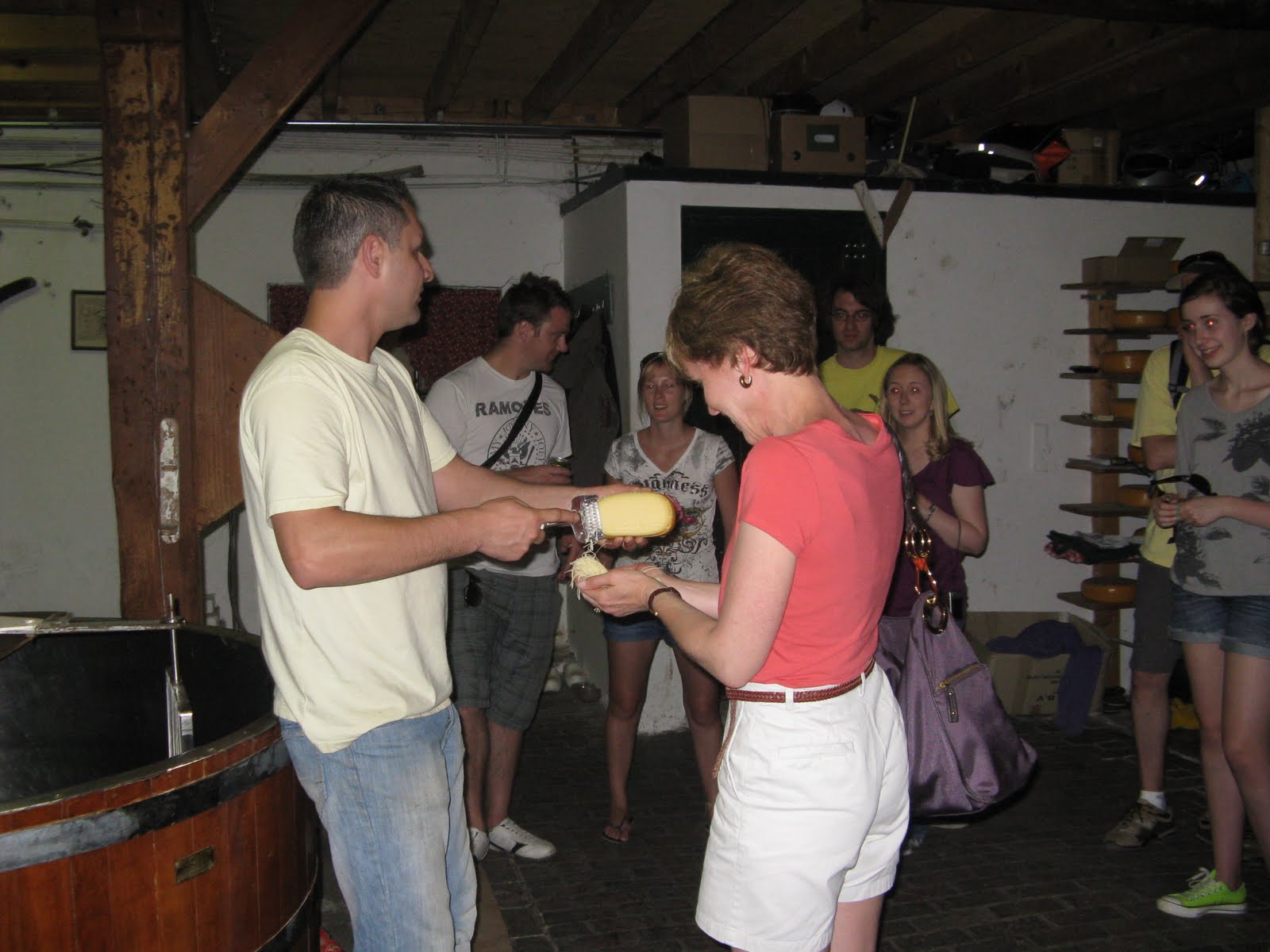
We first went to a windmill that was somehow used to pump water out of the wetlands (I am not an engineering student, but it sounded complicated). Next, we went to a cheese farm and clog, or wooden shoe, factory. The farm’s production of the cheese is not enough to export but the cheese is shipped throughout the Netherlands. The owner told us they made Gouda and sometimes put some flavor into it, Whitney asked if they made any other types of cheese and with a somewhat confused look said "uh... no, but if you wait long enough, it turns into Parmesan," because according to this farmer, Gouda is the real cheese. Then, we watched him make a shoe out of a block of wood, which took about 4 minutes and used some impressive machinery. My favorite part was that the owners/farmers were all wearing wooden shoes, which at first I believed to be a tourist gimmick, but when he took off one of his shoes and said "after four years, they wear through a bit," showing us a hole in the heel, I turned to Whitney and said "you know you are Dutch when you wear through a pair of wooden shoes."
We got some souvenirs and moved on, riding peacefully through the wetlands and forests of the "countryside" and learning that nothing is truly wilderness in Holland because every bit of land was under water or covered with Peat and then funneled into canals and chipped away and sold as fuel--making every inch somewhat man-made.
After returning, we relaxed for a while and got ready to go to the Red-Light District, the most anticipated part of our stay in Amsterdam. I won't go into any details, but only because there weren't any. While we were expecting the atmosphere of a sin-filled freak-show, the most shocking thing we saw was what appeared to be tourists from every country of the world, ages 10-80. All the women were clothed (at the very least in underwear and bras) and although the opportunity to go crazy was just around the corner, it was never in your face. Bored and underwhelmed, we returned our bicycles to the rental shop and went home to get some sleep before crossing town to meet up with our group and head to Berlin.
Amsterdam and Holland in general might have been the most beautiful, serene, enjoyable place we've been so far and is really the opposite of its stereotype in many ways. A relaxed, beautiful European town with tons of history and friendly locals of every nationality, Amsterdam is a place everyone should visit.
Thanks for reading and we should have a blog about Berlin coming before the end of the day.

Tuesday, June 29, 2010

Amsterdam Day 2


We woke up on our second day in Amsterdam with a fiery determination to find a bike rental
shop. Without too much trouble, we did find the one we were looking for and promptly
signed up for both the city tour of Amsterdam and the Country tour the following day of
the countryside surrounding the city. The city tour was at 4 in the afternoon, so after we got our rental bikes, we decided to do a little biking and walking around the town. Whitney found a clothing store that she'd apparently been waiting for all her life, and I actually found a couple nice light t-shirts while we were there, which was great because we've been doing nothing but sweating for the duration of our trip.

After lunch (two delicious sandwiches from a "lunchroom," which are found across the city) we strolled around a bit more and found some free WiFi at McDonalds before meeting back at Mike's Bikes for our tour.


We got a very brief history lesson of Amsterdam before even setting out on our bikes and
it was very interesting stuff. Amsterdam started as a place where religious folks would go
on pilgrimages (that's right, Amsterdam was a religious destination). The remarkable part
about Amsterdam is that it changed its identity and international role each time it needed to
in order to survive. It went from religious destination to the standard feudal system to
the leader in world trade (Dutch was at one time the universal language of business) to international superpower to a small and far less powerful country amidst Europe's superpowers, and finally, to the social/civil rights trailblazer it is today.

A couple interesting facts we learned from the tour: Amsterdam proper is made up of 90
different islands; prostitution has been legal since 1830 when it was regulated by
Napoleon; Vondelpark, which was the inspiration for Central Park in New Amsterdam (now
known as New York), is home to more than 360 tree species, more than any other park in
the world, and literally anything but sleeping is allowed in the park; there are over
120 nationalities represented in Amsterdam alone, during World War II, Amsterdam was occupied by the Nazis for the duration of the war and lost more than 25 percent of its population (Amsterdam had long been a popular Jewish destination due to its tolerance--or, rather, lack of intolerance); the city was eventually liberated by...you guessed it, the Canadians...


Since then, Amsterdam has been the center of the hippy movement in Europe, and was one of the
few countries in the world to legalize same-sex marriage.

After the tour, which was led by a somewhat uninterested New-Zealander guide, Whitney and I
were too hot, sweaty, and tired to do much more than get some cheap dinner at a lunchroom
(think Dutch Diner, but without the refills or booths) and lie in our beds. That was when
Whitney and I uncovered a most alarming conspiracy.

It is well-known that Americans don't have a great international reputation, we are
materialistic, often monolingual, uninformed about international events, and we had
George Bush as the face of our country for 8 years. But when Whitney and I turned on the
National Geographic Channel, the first program was about FBI, local police, and governmental
corruption in dealing with the Boston Mafia; not a great portrayal of the U.S. but not unique
to us either. We stayed tuned after the program ended and were treated to a compelling edition
of "American Hate" where they did a one-hour program about the New Black Panther movement and Black hate in America, as well as mentioning some quick facts about all the other hate
groups in our country. After that ended, they replayed the mafia program and after that they
replayed "American Hate." We didn't watch the encore presentations, but we suddenly realized
that American hate (that is, hate of Americans) isn't helped by stories of how hateful and
corrupt we are. Now, I am only half-serious, but it is a little alarming to see hour after
hour of repeating episodes about how evil America is.

Anyway, today we go on our tour of the Netherlands countryside and will hopefully get around
to going to the red light district. There should be plenty to tell you all after that happens.
Hope you're doing well, we miss you all, and thanks for reading.

Monday, June 28, 2010

Our first night in beautiful Sin City


I sure am going to miss speaking French. But Collin and I have completed our trip in Paris and have moved on to the next pond. And pond is actually the perfect word to describe our new destination: Amsterdam--which has more canals than Venice! I had no idea what to expect of Amsterdam. I imagined being dropped into the redlight district (which I thought would be dark, seedy,and dangerous) feeling frightened and out of my element.
I can't tell you yet if it is dirty, scary, and dark because Collin and I haven't ventured there yet. But I can tell you that Amsterdam as a whole is a whimsical and beautiful sight to behold.
As we approached, the city limits just looked like farm country (beautiful pastures that I was under the impression would soon turn in to dark caves of sin that lined the city streets). But once we entered the city, I was amazed. It is just beautiful. The canals were bordered by a row of boats on each side--old boats, quaint boats, slow boats that only seemed to move one at a time in the most picturesque fashion down the center of the canals.
Another, perhaps more surprising thing about Amsterdam is that it is like Eugene when it comes to bikes--tenfold.
There are a million bikes in this city. A million!
There are more people cycling than walking down the streets. Huge bike racks consume at least half of some blocks, and bikers have the right of way.
After walking about a mile and a half to our hotel from the Busabout drop-off point, Collin and I quickly dropped our bags in our room and set out to find ourselves some bikes.
Collin is a genious about getting around almost every city, and even he couldn't save us from wandering around what we thought were the right streets for about 45 minutes before we forfeit our search for some wheels and found our way to a busy square for dinner.
The streets in Amsterdam follow the canals, and the canals surround the city center in a series of rings, so you can imagine the navigational difficulty of circular streets that all have names like Stadhouderskade and Nieuwesijds Voorburgwal.
After not-so-good food, we asked for a bus map of Amsterdam so that we could find our way across the city. In Paris and London, we just rode public transportation to get a good look at the greatest number of sights in the least amount of time, so we thought we would do the same for Amsterdam.
But this city seems to be a little too preoccupied to create a cohesive plan for public transportation, so we ended up just walking back.
Along the way we saw all of the run-of-the-mill Amsterdam shops: adult shops, "coffee shops," high-end fashion shops, bike repair shops, and various others that were unrecognizable because they had already closed by 7 p.m.
This city has been pretty affordable so far. Cheap dinner and cheap accommodations. We are hoping to go on as many bike tours as we can over the course of our trip, starting tomorrow here in the city and the next day out into the country. We decided that it is best to shell out a little cash so that we have an idea of what we are photographing, so keep your eye out for some gorgeous photos in our next blog!